By Rahul Sharma, founder of Seospidy. Published 1 November 2026.
Every site with a contact form: the DPDP Act
The Digital Personal Data Protection Act, 2023 covers any business that collects personal data, and a contact form collecting a name and a phone number counts. The DPDP Rules were notified on 13 November 2025 and come into force in phases:
| From | What starts |
|---|---|
| 13 November 2025 | The Data Protection Board and procedural parts |
| 13 November 2026 | Registration of consent managers |
| 13 May 2027 | Notice and consent, the duties of businesses holding data, children's data, people's rights over their data |
The notice you show before someone submits a form will need to be clear and separate from other text, list the data you collect, say what you'll use it for, and give a way to withdraw consent and to complain. If there's a breach, the Board and the people affected must be told, with a detailed report to the Board within 72 hours.
What we do on every form we build: a short notice beside the submit button saying what's collected and why, no pre-ticked boxes, and a privacy page that says how to ask for data to be deleted. It costs nothing to do this now, and it saves rebuilding forms in 2027.
Sites that sell: the E-Commerce Rules, 2020
If your site sells goods or services online, the Consumer Protection (E-Commerce) Rules, 2020 apply. Your site needs to show:
- your legal name, address and contact details
- a grievance contact
- return, refund, exchange and cancellation policies, in plain words
- for imported goods, the importer's details
- explicit consent at checkout, never a pre-ticked box
Sites that sell packaged goods: Legal Metrology
Product pages for packaged goods must carry the same declarations as the pack: manufacturer or packer name and address, country of origin, common or generic name, net quantity, MRP, best-before or expiry date where relevant, and size or dimensions. Country of origin on e-commerce listings has been mandatory since July 2020. The penalty under Rule 32 of the Packaged Commodities Rules runs up to ₹5,000.
Design tricks you should avoid: dark patterns
The Central Consumer Protection Authority issued guidelines in 2023 against "dark patterns", the design tricks that push people into buying or agreeing. Fake countdown timers, items slipped into the basket, "No, I don't want to save money" buttons, charges revealed only at the last step, and subscriptions that are hard to cancel are the familiar ones. A clean site with honest prices doesn't need any of them.
Special cases
- Doctors and hospitals follow the National Medical Commission's advertising guidelines issued on 6 October 2026: no patient testimonials, no before-and-after photos, no "best" or "No. 1" claims.
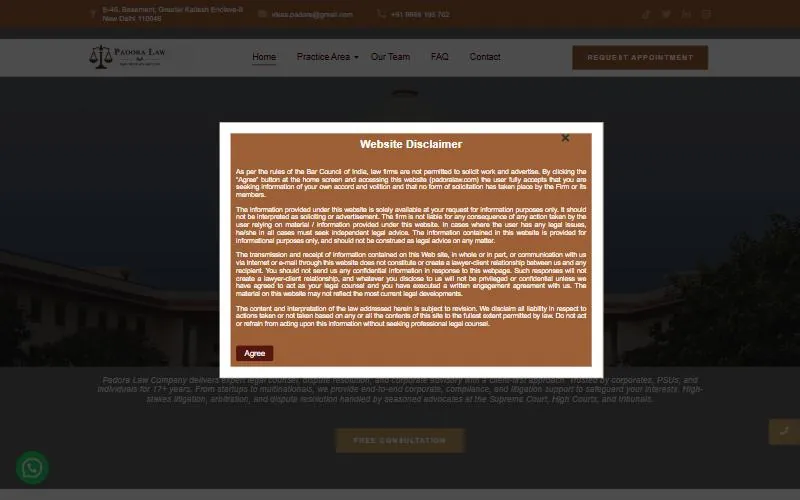
- Advocates can't advertise or solicit under Bar Council rules; most law firm sites open with a disclaimer that visitors accept before reading.
- Chartered accountants follow ICAI's code on advertising and website content.
- Coaching institutes have their own requirements: see what a coaching website must show.
The short checklist
- A privacy notice beside every form, and a privacy page
- Your registered business name, address and a contact that works
- Refund and cancellation policies if you sell anything
- Legal Metrology fields on every packaged product
- No pre-ticked boxes, fake timers or hidden charges
- Your profession's own rules, if you're a doctor, advocate, CA or coaching centre
If you'd like us to check your site against this list, send us the link. It's free.
 RCJN Jewellers
 Padora Law
 Dream Realms
 Microbase Equipments